
Our AI Forum provided a space to explore, and a step to more
Common Cause Australia recently surveyed our email subscribers about their use of AI, the benefits they perceived, and their concerns.
We were blown away by the 278 responses we received. You can find a summary of findings at the end of this post. In short, while most people are using AI in some form, everyone has some concerns – about ethics, privacy, data centres and more.
We also heard strong interest in attending an AI Forum, which we ran together with Digital Rights Watch on 15 September 2026 (recording here). After the opening presentation, we turned off the recording and had some very frank and fearless conversations about AI!
AI truly is a common cause, spanning democracy, workers’ rights, gender equality, climate change, water, land theft, copyright, artists’ rights and more.
Where to from here?
Our foray into investigating AI and hosting the Forum was a worthwhile but unfunded side-quest. We’ll continue to stay involved and share updates in our newsletter. But for now we’re mostly handing over to our co-conspirators in this space, Digital Rights Watch.
COMMUNITY OF PRACTICE
Interested in joining a community of like-minded people concerned about AI in the workplace?
There were so many great conversations and ideas that came out of the forum and we want to keep the conversation going!
Digital Rights Watch are inviting you to join a flexible and accessible community to learn from each other as we navigate how AI is impacting how we work.
If you're interested in working in a co-design environment where we work together on the challenges and benefits of new technology, please sign up here.
No matter where you sit on the keen-to-aghast spectrum, we’d encourage you to keep having conversations about AI and its use so that decisions are based on awareness and consent.
You can also check out the links below shared by Forum participants, ourselves and Digital Rights Watch.
LEARN MORE
Interview with Karen Hao, author of Empire of AI: Is A.I. the new colonialism?
Purpose-built AI for Maori language revival: A new vision of artificial intelligence for the people | MIT Technology Review
Article highlighting the role modern-slavery conditions play in data labeling for LLMs
MIT report: 272 international AI experts’ prioritisation of AI risks.
EXISTING CAMPAIGNS
Digital Rights Watch campaigns
Data centres: Greenpeace, 350
Workers’ rights: ACTU Statement on employers’ obligation to consult about introducing AI; UTS AI-powered worker surveillance
Copyright, artists’ rights: Interview with Holly Rankin / Jack River
Examples of European advocacy: AI should serve us, not tech billionaires | WeMove Europe + PauseAI.
HOW TO USE AI BETTER
Champions of Change Coalition: Inclusive AI pledge and prompts
The Research Society: Using AI Responsibly in Research
HOW TO AVOID USING AI LLMs (e.g. ChatGPT, Claude, Gemini)
Duckduckgo search engine, NoAI: https://noai.duckduckgo.com/
Explore running a private local AI tool, including open source models: https://www.datacamp.com/tutorial/run-llms-locally-tutorial
Summary: Common Cause AI survey findings
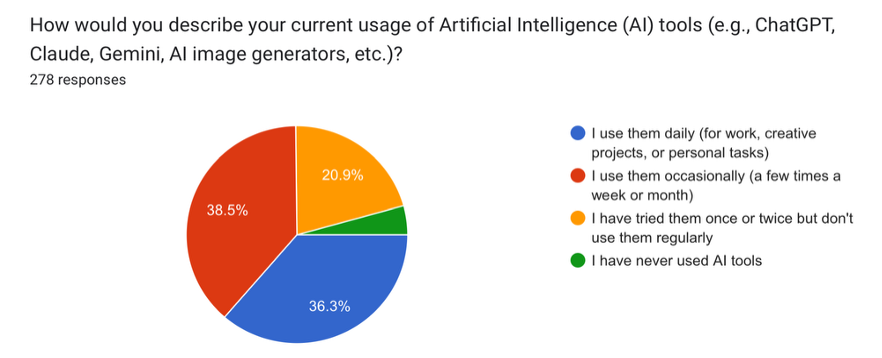
Three-quarters of our survey respondents use AI tools such as ChatGPT, Claude and Gemini (LLMs) daily or fairly regularly:
Most respondents use them for writing or editing text, and research, brainstorming or learning new topics:
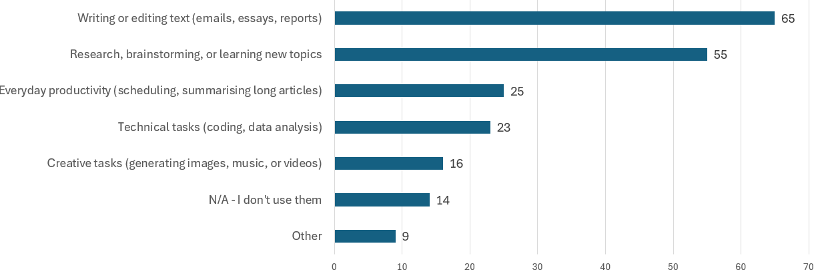
Percentage of survey respondents who selected each option.
What do you think are the potential benefits of AI in your daily life or for the causes you care about (if any)?
● Productivity, freeing up time for strategic thinking: Many respondents said they use AI to more quickly perform admin/tedious/non-creative tasks such as summarising meetings and data entry and analysis. “Outsourcing” those tasks to AI has increased capacity for higher-level strategic work and critical thinking.
● Comms support: Help with brainstorming, overcoming "blank page" syndrome, refining tone.
● Accessibility and equity: Some neurodivergent people and people with disability said AI tools helped with task management, scripting social interactions, and plain-language summaries of texts. AI also allowed self-employed people with disability to reduce their work hours while still sustaining themselves financially.
● “Doing more with less”: For under-resourced organisations, AI provided a way to "do more with less", to respond to increasing workloads with reduced resources.
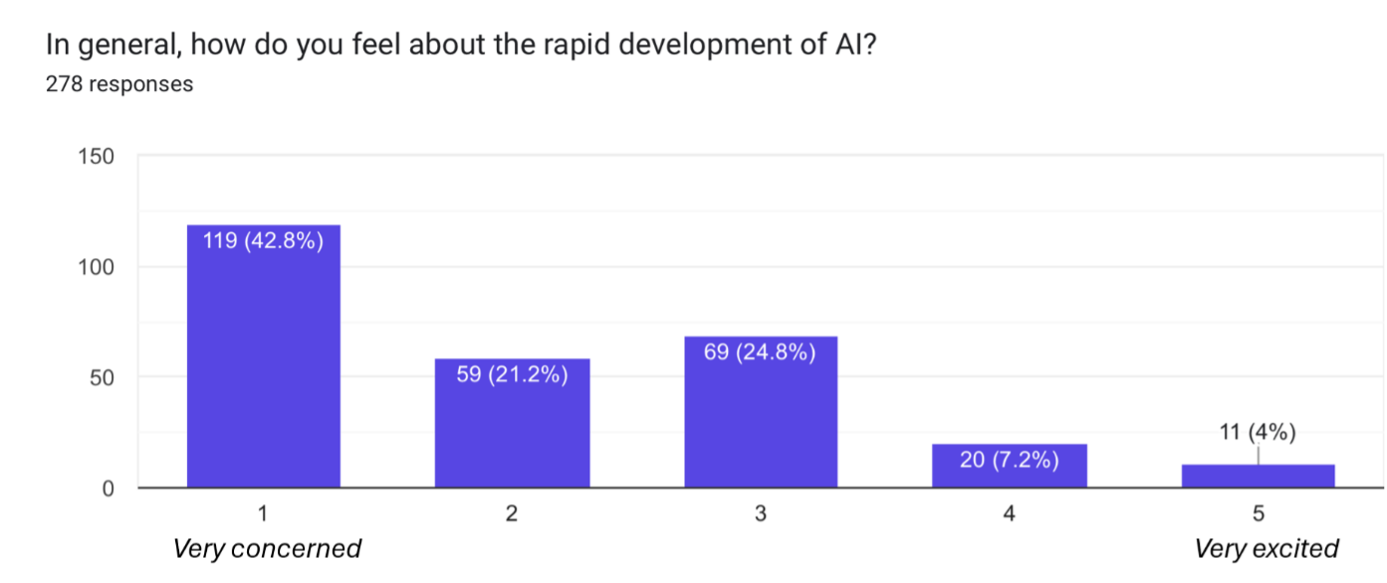
Two-thirds are “very concerned” or “concerned” about the rapid development of AI:
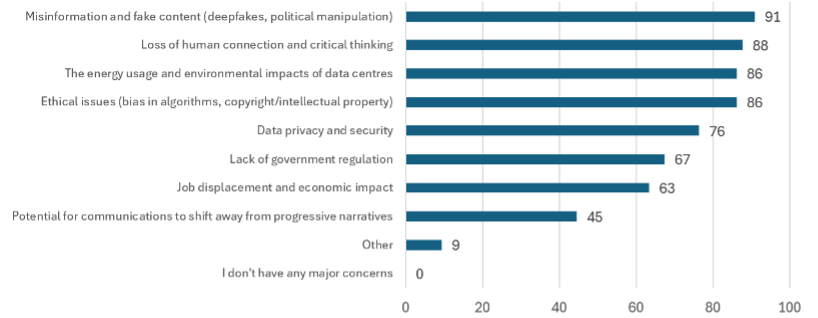
Top concerns centre around misinformation and fake content, loss of human connection and critical thinking, the energy and environmental impacts of data centres, and ethical issues such as bias in algorithms and copyright/intellectual property:
Responses to ‘do you have any other thoughts you'd like to share about AI?’
● AI problems are baked in by design: AI is being designed by techlords who don’t have our interests at heart. e.g. “It is not AI itself that concerns me but the fact it is being monitored by the tech broligarchy with only the profit motive and no controls”.
“The foundations of AI are so concerning - how do we harness something that treats human connection and critical thinking as redundant, data as a means to control, and the natural world as collateral damage?”
● Need for government regulation: Unchecked power of private tech companies due to lack of government regulation. Legislation is needed to hold corporations accountable for the environmental, social and ethical impacts of AI.
● Impacts on local communities, environment, climate: Concern about the impact of AI data centres, especially energy and water consumption. Also being imposed on communities without consent, taking land.
● Ethical issues: Exploitation of labour, theft of intellectual property, reinforcement of systemic inequalities, bias and discrimination.
● Impact on quality of work, skills, erosion of creative and critical thinking: “AI slop” is sometimes used in analysis or comms without critical reflection. Concern that reliance on AI for writing and problem-solving is eroding human critical thinking and analysis, creativity and language skills. E.g. “I do wonder if I am de-skilling myself because of my reliance on AI.”
● Dehumanising: AI is replacing authentic human expression, connection and experience. Deepfakes and the like are also eroding trust. E.g. “The one thing that's important for people to live well together that AI doesn't have and never will, is lived experience... AI is completely unfeeling, unavoidably so, and yet it feigns feeling quite well and so gets a level of credibility that it hasn't earned, and frankly, can't ever achieve. It's not actually intelligent but it is definitely artificial.”
● Workplace pressures and job replacement: Pressure to adopt AI by employers, without consent, adequate training and understanding of risks. A view that increasing use of AI is a “necessary evil” or “inevitable” is becoming a self-fulfilling prophecy. AI is already taking people’s jobs, particularly entry-level roles.