
Why most people are persuadable
Take a quick moment and answer this question:
What do you see in the image below?
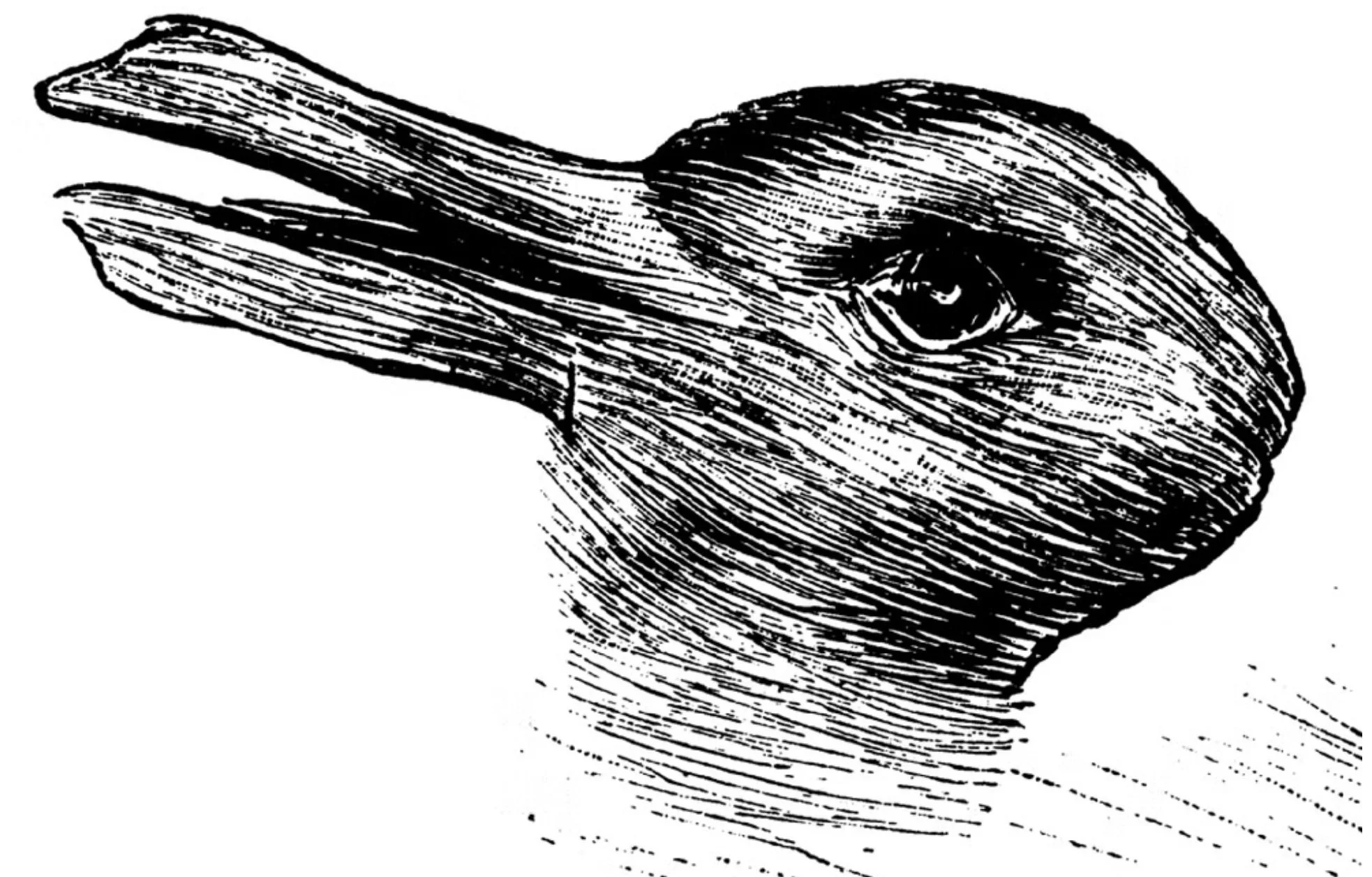
Some people see a duck, looking to the left. Others see a rabbit, facing right. And once it has been pointed out, most people can switch between the two.
This simple image is known as the duck–rabbit illusion. It is often used to illustrate a powerful idea from cognitive framing and political psychology called biconceptualism.
One image. Two meanings.
Nothing in the picture changes. The pixels on the screen stay exactly the same.
What changes is the frame you use to interpret them.
When you are seeing the duck, you are not seeing the rabbit. And when the rabbit snaps into focus, the duck drops away. Both interpretations are real, coherent, and internally consistent. But they cannot both be active at the same moment.
That is biconceptualism in a nutshell: the human capacity to hold more than one conceptual framework about the same thing, even when those frameworks lead to very different conclusions.
Why this matters for communication
If you work in communications, advocacy, or social change, you have almost certainly heard this well meaning, but misleading, advice: “You have to meet people where they’re at.”
On the surface, it sounds sensible. Respectful, even.
But it rests on a flawed assumption: that most audiences are in one fixed place on most issues.
They are not.
Most people are biconceptual on most contested topics. They already have multiple ways of understanding the same issue, just like the duck and the rabbit. Which one they use depends on context, language, cues, and framing.
At Common Cause Australia, we refer to these people simply as ‘persuadable’. Across dozens of research projects on social justice, health and environmental topics, we have found persuadable people constitute between 55-75% of the population.
Persuadable people can believe that:
poverty is caused by bad personal choices and also an unjust economic system
climate change is real and also economic growth must come first
public health matters and also personal freedom should be protected
trans women have a right to be themselves and also not compete in sport or use women’s toilets
These are not contradictions in the way people normally think. They are different frames, activated in different moments that make people feel very differently about what is right and wrong.
Take them somewhere better
Once you truly grasp biconceptualism, a lot of conventional communications advice starts to look inadequate.
If people are already capable of seeing the duck and the rabbit, then your job is not simply to meet them where they are - because that fixed place is a myth.
Your job is to take them somewhere better. In practice, this means:
activate the frame that leads to better understanding
make that frame feel intuitive and morally right (by engaging helpful values)
repeat the frame until it becomes the dominant way they interpret the issue
In other words, persuasion is about taking them to a place they are already capable of going - and doing so consistently.
The gut-level test
The most effective framing does not feel like persuasion to the audience. It feels like recognition.
When the frame clicks, people experience a gut-level sense that:
“Yes, that’s what’s really going on here”
“Of course that’s the right thing to do”
“Why wouldn’t we act this way?”
That moment is the duck appearing where there was once only a rabbit.
And once someone has seen it, it becomes very hard to unsee.
The real takeaway
The duck–rabbit illusion reminds us of something both hopeful and demanding.
Hopeful, because most people are persuadable. They are not stuck. They are not unreachable. They already carry multiple ways of seeing the world.
Demanding, because it places responsibility back on us as communicators. If people are not moving, it is rarely because they are incapable. It is often because we are activating the wrong frame.
The work is not to argue harder.
The work is to help people see what they are already capable of seeing.
If you’d like to learn more about how to apply framing to your work you can join one of our regular public training programs, or check out our ever growing list of message guides in which we’ve already done the hard work of sorting out the helpful frames from the bad.
And… just for fun
If you want to see what the duck-rabbit illusion looks like in real life, check out this image of a kookaburra that has been confusing the internet, by looking like a rabbit.

And then there’s this one kinda looks like a goat?